

Looking Back to Design Forward
What historic houses can teach us about creating timeless kitchens and interiors
Whenever we visit a historic house, I inevitably find myself heading for the kitchen.
I love the grand rooms, architecture and collections, but it's often the working parts of a house that I find most inspiring. Kitchens, pantries, larders and sculleries show us how people actually lived — the materials they used, how furniture was made and all those little practical details that made a room work.
Living and working in Norfolk, we are rather spoilt for inspiration. Felbrigg Hall and Blickling Estate are practically on our doorstep, while our travels have taken us to houses further afield, including one of my favourites, Lanhydrock in Cornwall.
What strikes me is how many ideas we think of as current have actually been around in one form or another for generations.
At Fox & Bear, these historic interiors often find their way into our kitchen and interior design work here in Norfolk — sometimes consciously, sometimes without us even realising it.
We aren't interested in recreating a Victorian kitchen or making someone's home feel like a museum. But there is a great deal we can learn from these houses.
Perhaps looking backwards is sometimes one of the best ways to design something that will last.
Designed to work
Historic kitchens were working rooms first and foremost.
At Felbrigg, the kitchen still contains two wonderful long oak work tables, while the wider working areas of the house included larders, a scullery and other rooms, each with its own purpose.
That feels surprisingly relevant to the way we're designing homes again today.
The pantry has well and truly returned.
We are designing walk-in pantries, breakfast cupboards, utility rooms and dedicated storage rather than expecting one kitchen — and one bank of cabinetry — to do absolutely everything.
Our refrigeration has changed considerably, of course, but the principle hasn't: give things a proper place according to how they're used.
The same is true of innovation.
At Lanhydrock, the Victorian kitchen was full of the technology of its time. Today we have dishwashers, boiling-water taps, venting hobs, integrated lighting and clever internal storage.
A traditional-looking kitchen doesn't need to reject modernity. Quite the opposite.
I love the juxtaposition of a beautifully aged brass tap that also delivers boiling water, or traditional painted cabinetry concealing completely modern appliances.
From reclamation yard find to showroom centrepiece — a story for another Design Notes...
Old and new don't have to compete.
Natural materials that get better with age
Oak. Walnut. Marble and stone. Brass. Bronze. Ceramic. Painted timber. Linen.
These materials have been used in homes for generations, and we're seeing a real appreciation for them again in contemporary kitchen and interior design.
They aren't perfectly uniform and they don't necessarily look exactly the same ten years after installation. Timber mellows. Brass develops a patina. Stone has its own markings.
And that's rather the point.
We often talk to clients about living finishes — materials that are allowed to change as they're touched and used. An unlacquered or aged brass handle doesn't need to remain pristine forever. Its character becomes part of the room.
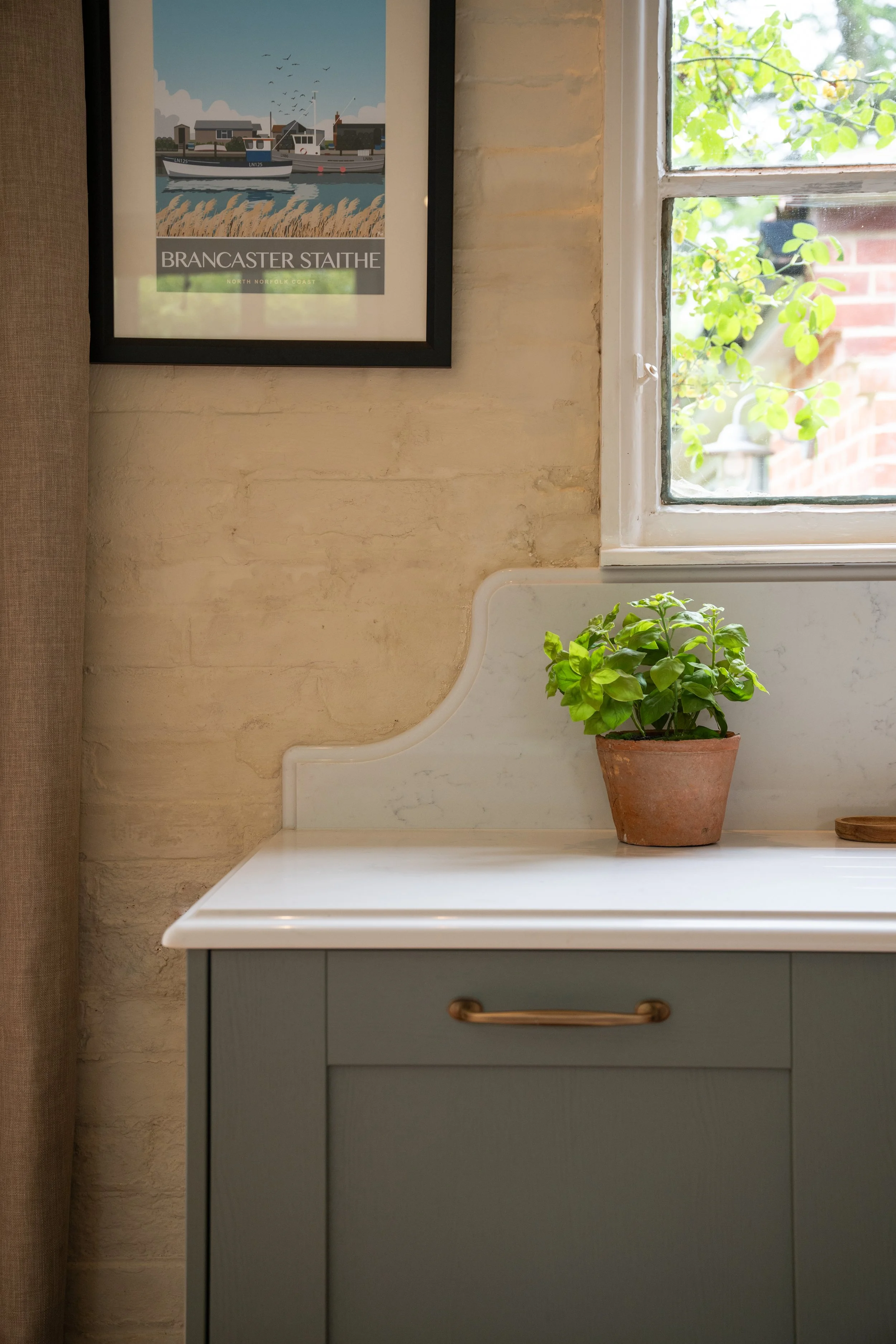
Splashback edge detail and brass handle.
We're using more oak and walnut in our work too, sometimes as complete pieces of bespoke furniture and sometimes simply as a detail alongside painted cabinetry.
There is a warmth and honesty to natural materials that is difficult to replicate.
And it's not only the big things.
One of my favourite things to do in an old house is look at the details: a handle, a latch, a row of hooks, a shelf bracket, a wall light, a tiled surface or the shape of a piece of stone.
They were functional things, but somebody still considered how they should look.
That thinking has a strong influence on the details we use at Fox & Bear today. Beautifully made hardware, traditional forms of lighting and switches, aged metals, ceramic sinks, shaped stone and handmade tiles can all reference the past without creating a period interior.
We use makers and suppliers such as Pooky and Corston Architectural Detail for exactly this reason — traditional references interpreted beautifully for contemporary homes.
A handmade tile won't be absolutely identical to the one beside it. Timber has grain. Linen has texture. Cast metal has variation.
Those differences are often what make an interior feel personal, tactile and collected rather than manufactured all at once.
An old idea, used differently
Perhaps the best example of all of this is sitting in our Fakenham showroom.
Our chef's table started life as an old Victorian table.
Rather than simply restoring it as a dining table, Anthony adapted it for the way we live now. It became a kitchen island, prep table and breakfast bar, with a new worktop and practical details such as a towel rail, while retaining its beautiful original turned and reeded legs.
It isn't a reproduction Victorian kitchen island.
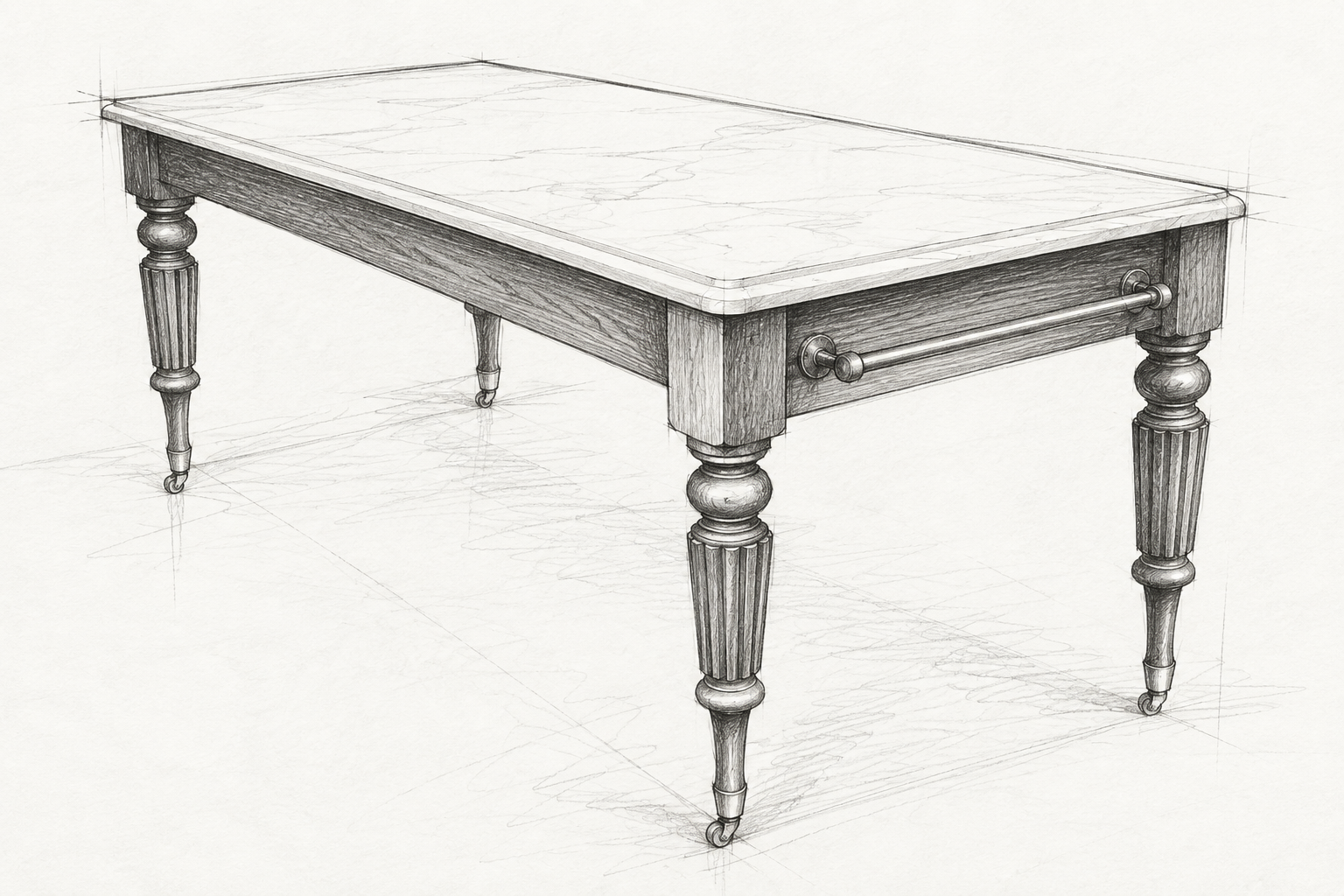
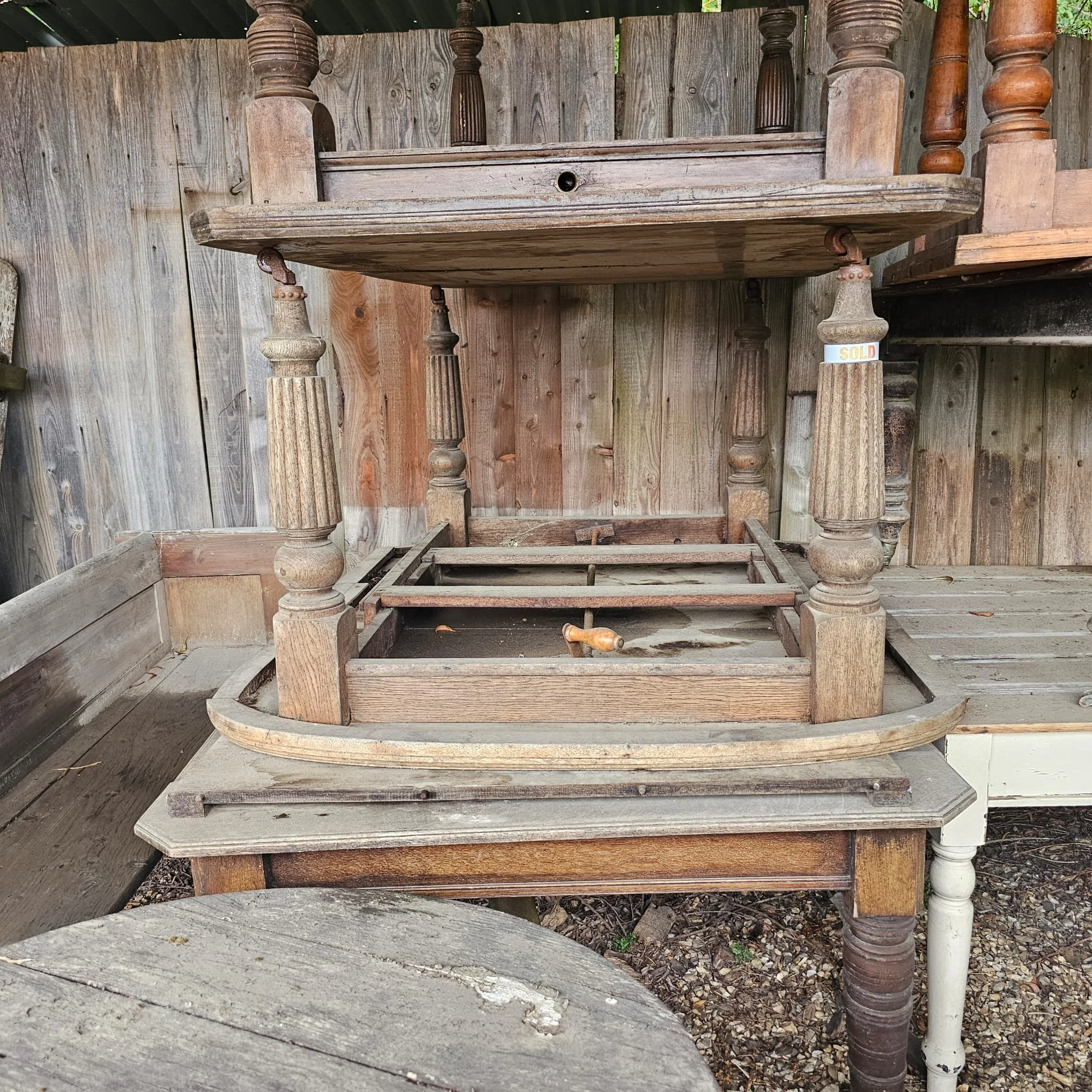
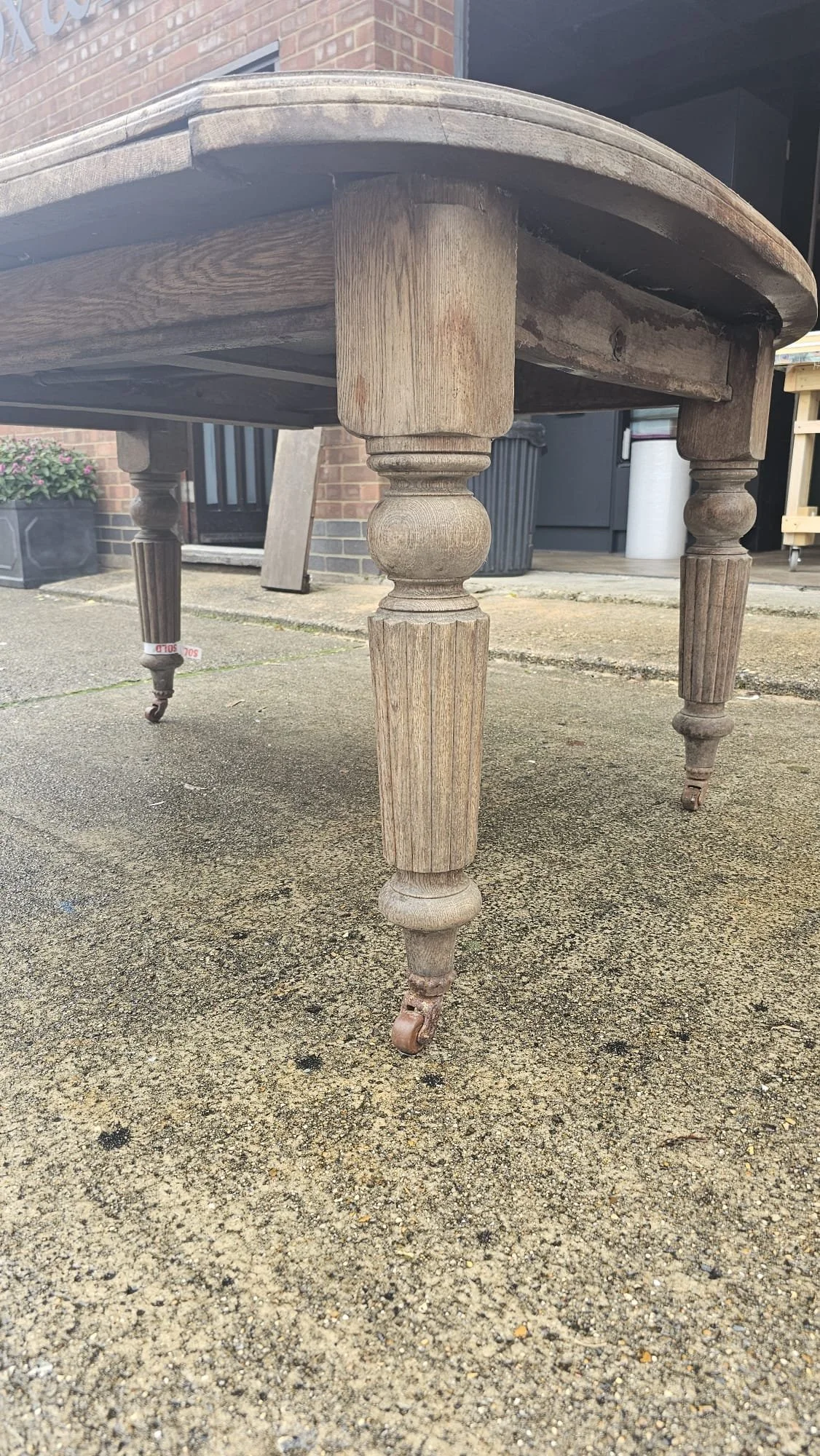
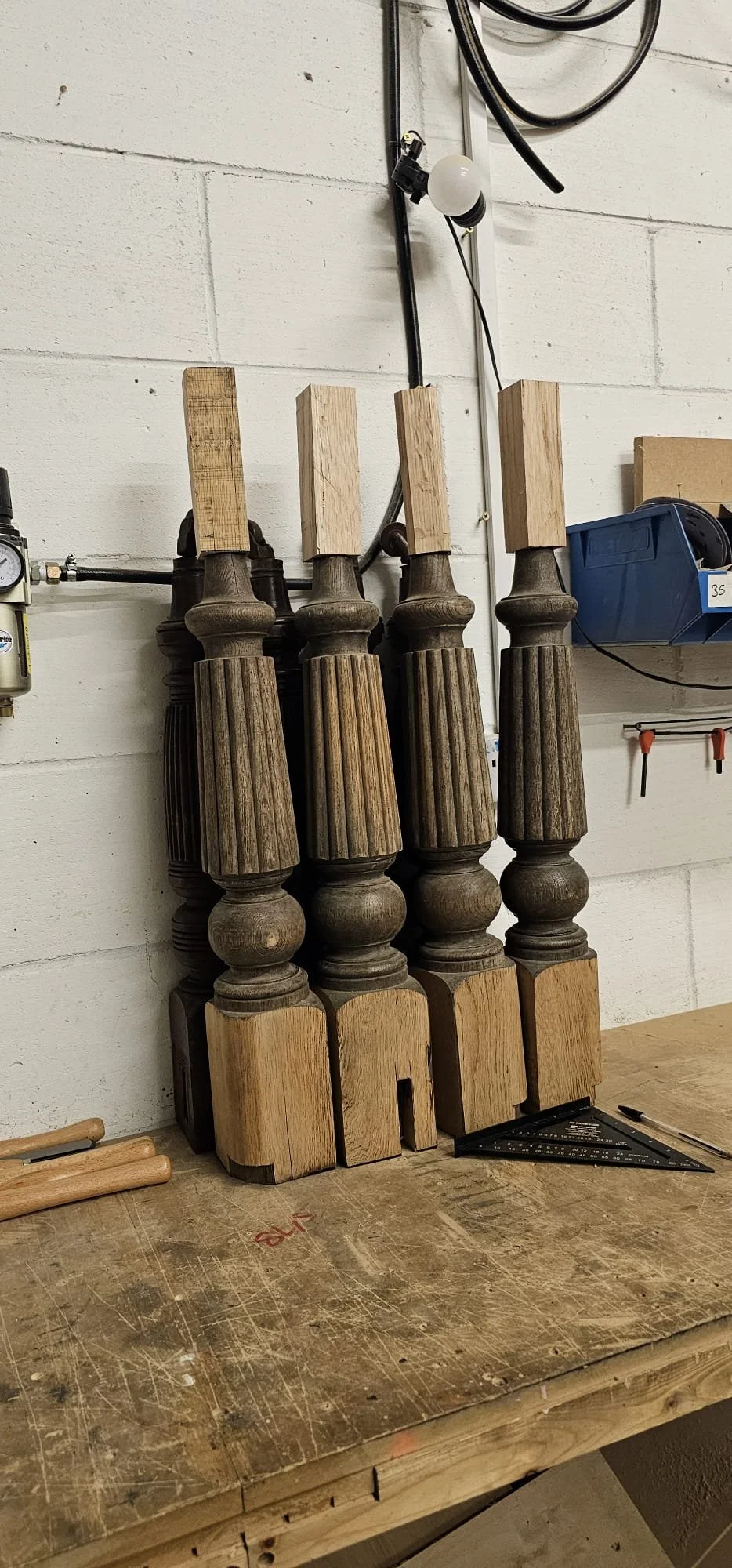
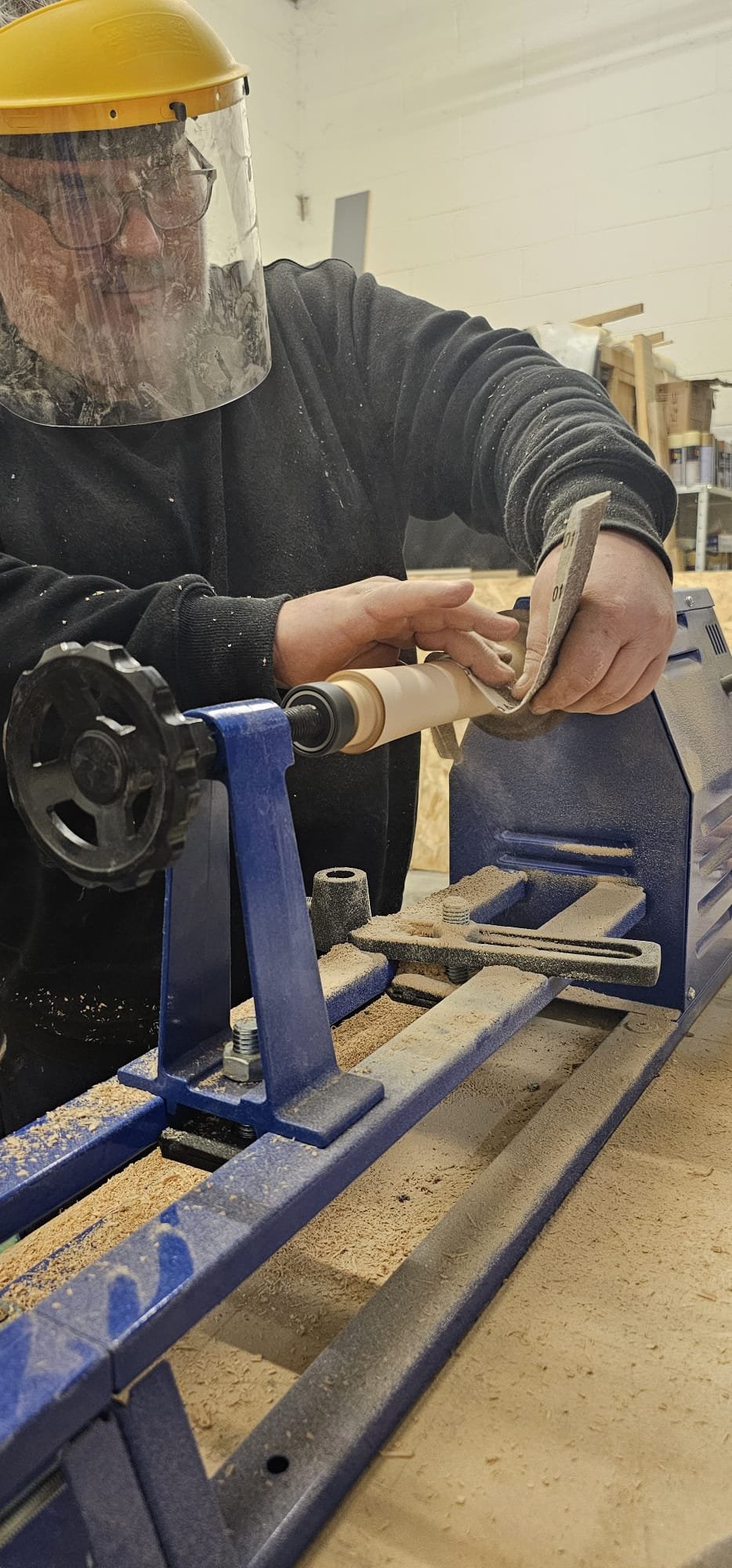
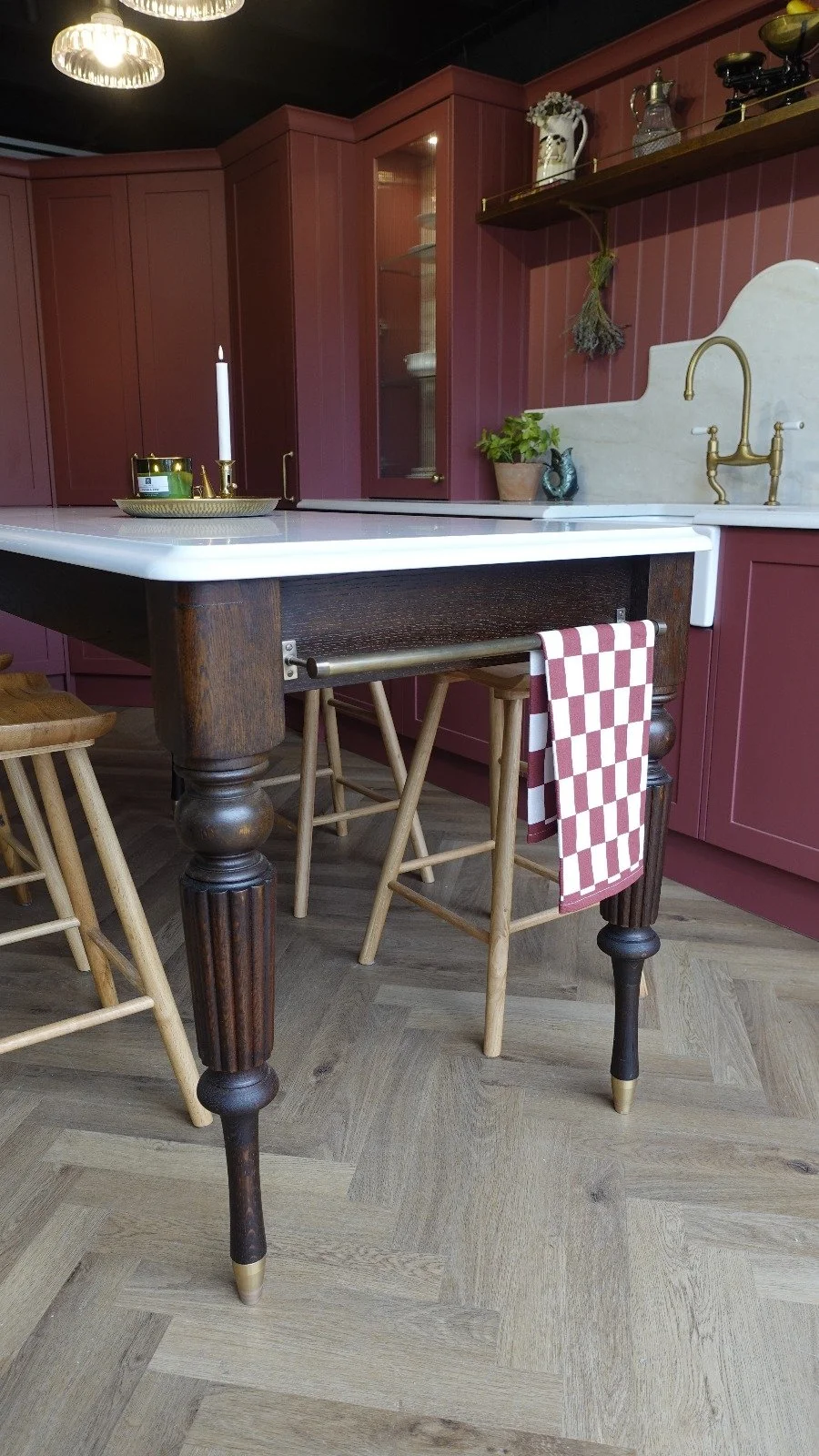
It's an old idea translated into something useful now.
A freestanding prep table gives a kitchen a very different feeling from a conventional fitted island. It feels like furniture and can be designed around the proportions of the room rather than forcing the room to accommodate a standard size.
It's an idea we particularly love for character and period properties, of which we have rather a lot here in Norfolk.
The same thinking applies to pantries.
Not every house has room for a walk-in pantry, so sometimes we create one inside a cabinet: storage, worktop space, sockets and shelves hidden behind doors. Close it and the kitchen becomes calm again.

Walk-in pantry.
Breakfast cupboards, drinks cabinets and appliance cupboards work on the same principle.
The form has changed. The idea hasn't.
A home should tell a story
Historic houses weren't minimalist.
They were layered with furniture, books, paintings, ceramics, textiles and objects collected over time.
That's something else we like to borrow.
We sometimes use wallpaper or fabric behind glazed cabinetry, turning a practical cupboard into somewhere for beautiful glassware, ceramics and collected pieces — almost a contemporary cabinet of curiosities.
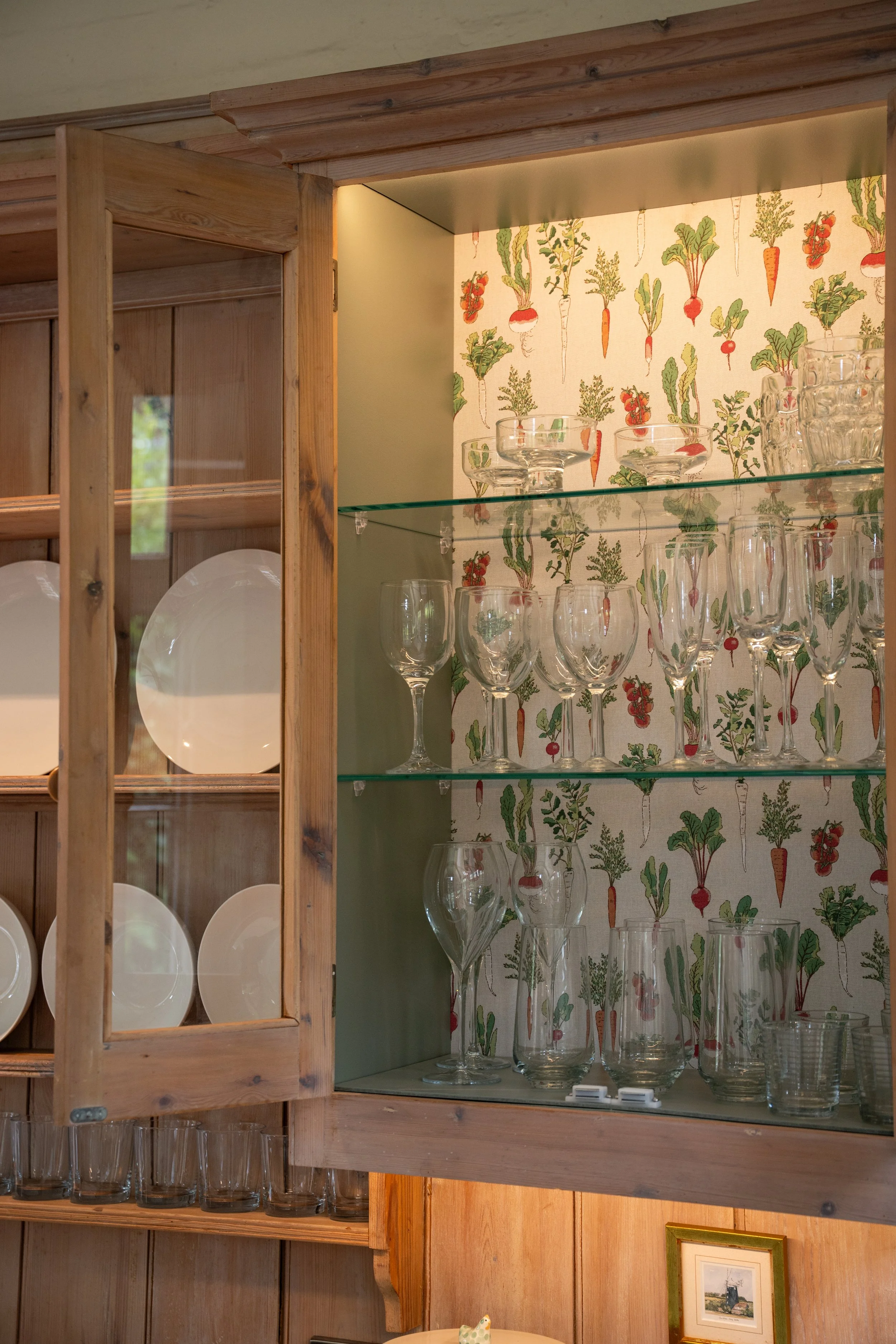
Fabric behind glazed cabinetry.
And we like leaving room for little vignettes: a lamp on a worktop, a painting, old chopping boards, cookbooks, pottery, flowers or something brought home from a trip.
A kitchen needs to function brilliantly, but it's also a room in someone's home.
Not every centimetre needs to work as hard as possible.
Sometimes the detail that isn't strictly necessary is the thing that gives a room its personality.
This is probably a Design Notes subject all of its own. We have a particular weakness for antiques, car boot finds and pieces with a previous life — and increasingly find ourselves mixing them into new interiors.
More on that next time.
Finding inspiration in Norfolk — and beyond
Our materials library in the Fox & Bear showroom in Fakenham is constantly growing.
Alongside timber, stone, paint, hardware and fabric samples, we've started building a little collection of books on historic houses, architecture, furniture and Victorian and Edwardian interiors.
Sometimes the starting point for a project isn't another contemporary kitchen at all.
It might be the shape of a table in an old photograph, a pantry colour, an unusual handle, the edge of a piece of stone or the proportions of an old cupboard.
If you're visiting our showroom, you're very welcome to sit down, pull out a book and have a rummage.
And nothing quite replaces seeing the real thing.
We're incredibly lucky to have historic houses such as Felbrigg Hall and Blickling Estate here in Norfolk, while places further afield such as Lanhydrock continue to send us home with photographs, sketches and far too many ideas.
They remind us that good design doesn't need to belong to a particular decade.
Timeless isn't a style
I don't think creating a timeless interior means choosing everything neutral or avoiding anything fashionable.
And it certainly doesn't mean copying the past.
For us, it's about understanding why certain things have continued to work: natural materials, good proportions, practical layouts, craftsmanship, thoughtful details and furniture designed around the way people actually live.
Then we can add everything that makes contemporary life better.
The dishwasher can stay.
So can the boiling-water tap.
We just might put them alongside a Victorian table, an aged brass handle and a beautifully figured piece of walnut.
The best ideas don't necessarily belong to one period. Sometimes they simply deserve another chapter.